Thursday, March 8, 2012

The Danger of Giving Energy Drinks to Young Athletes

In June 2011, the American Academy of Pediatrics took the position that there is a difference between “sports drinks” and “energy drinks”. This distinction is important to adolescents and is also a microcosm of the American way of life.

As a nation we often seek the most efficient, if not the easiest, way to get a job done. Unfortunately, when it comes to athletic activities, there is no substitute for good old-fashion hard work and persistence.

What Makes Energy Drinks so Dangerous?

Many adults and adolescents will seek that little additional edge in their performance by using supplements. Energy drinks often contain “non-nutritive stimulants” such as caffeine and can run the gamut from 160 mg of caffeine per 8-ounce serving to 300 mg. The exact content and purity of energy drinks cannot be guaranteed since there is no regulatory control over these “supplements” and there may be harmful interaction with prescriptions to control ADHD.

Cola drinks and coffee are also sources of caffeine but possibly due to their long history and wide acceptance by the American public they do not often enter into the “energy drink” conversation. In the United States, cola drinks are controlled by the Food and Drug Administration (FDA) and are limited to 71 mg of caffeine per 12-ounce serving while 8-ounces of generic coffee has 95-200 mg per serving.

The Link Between Energy Drinks and Heart/Liver Problems

The National Federation of State High School Associations’ position statement on energy drinks states “energy drinks are not appropriate for rehydrating athletes during physical activity and should not be used for that purpose.” The consumption of energy drinks in teens has been linked with heart arrhythmias and liver problems. Last year the Virginia High School League became the first state high school federation to impose a ban on such drinks at high school competitions and practices.

Adolescents should not be viewed as miniature adults. Their biological systems are still developing and may react to outside influences differently than adults.

Combining Energy Drinks with Alcohol

The combination of energy drinks with alcohol can be dangerous for teens. According to the government’s Substance Abuse and Mental Health Service Administration, emergency room visits associated with energy drinks use increased nationally more than ten-fold from 2005 to 2009. Forty-four percent involved combination with alcohol, pharmaceuticals or illicit drugs.

What Makes Sports Drinks Different?

Sports drinks were developed to focus on fluid, carbohydrate and electrolyte replenishment to aid in athletic performance and recovery - typically with a 6-8% carbohydrate concentration.

The Best "Supplement" For Young Athletes

Young athletes should practice and compete without artificial supplements. The best “supplement” for teens is still hard work, eat a well-balanced diet, drink plenty of fluids and get adequate amounts of rest.

Find Safe Sports Drinks, Water Hydration Systems, Cups, Coolers, and More For Your Thirsty Athletes >>

www.nfhs.org
American Academy of Pediatrics. Clinical Report. Sports drinks and energy drinks for children and adolescents: are they appropriate? Pediatrics 2011; 6: 1182-1189
Homes News Tribune newspaper, December 11, 2011 www.THNT.com

Phil Hossler, ATC has been an athletic trainer on the scholastic, collegiate and Olympic levels. He has authored 4 books and numerous articles and served as an officer in state and regional athletic training associations for 20 years. He is a member of four halls of fame including the National Athletic Trainers’ Association’s.

Thursday, March 1, 2012

The Best Place for Gatorade or Water Coolers While on the Field

A Creative Solution for Hydrating Athletes

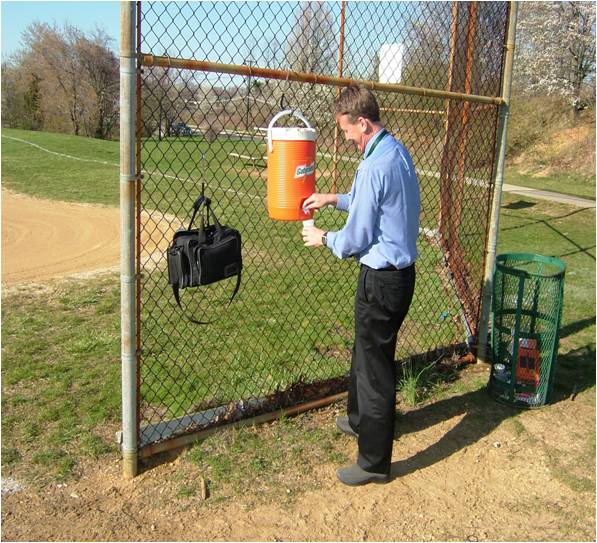
Using coolers for outdoors sports is a standard idea which can pose unique problems. For example, where can it be positioned so as not to take a seat on the bench, be on the ground making cups/bottles difficult to fill or get caught in the dust and dirt common to dugouts?

At a local hardware store, I purchased two standard rafter hangers. These are designed to go over the top of a 2”x 4” rafter beam and provide an arm for hanging items such as bicycles. Each hanger cost less than two dollars.


Sports such as baseball, softball, track and lacrosse commonly have fences around the field, in front of the dugout, or behind the bench. A very simple and inexpensive method to facilitate safety and ease of operation is to hang the cooler on the top rail of the fence (typically a 5-foot fence), on the fence itself or in the corner of the backstop.

Begin by positioning the cooler next to the fence. Place the longer arm into the handles of the cooler. By holding both the hanger and the handles of the cooler, lift the cooler up and place the hook end of the hanger onto the top rail of the fence. This places the spout at a very convenient level for the team to refill cups and bottles.


This idea can be used with coolers of all sizes. With handles across the top of smaller coolers, one hanger would suffice. First aid ice containers and first aid kits can be positioned in clear view with this simple hanger idea as well.

To improve hydration and replenishment for your athletes consider purchasing Gatorade, coolers and cup racks, and cups and bottles from www.esportshealth.com.

Phil Hossler, ATC has been an athletic trainer on the scholastic, collegiate and Olympic levels. He has authored 4 books and numerous articles and served as an officer in state and regional athletic training associations for 20 years. He is a member of four halls of fame including the National Athletic Trainers’ Association’s.

Wednesday, February 15, 2012

Tips for Designing an Effective Athletic Training Room


When given the opportunity, athletic trainers would love to have input on the creation, design and implementation of a new athletic training room. A new “home” for athletic trainers could be realized via newly constructed buildings or through renovation of existing structures.
Many components are beyond the building personnel’s input since they are dictated by local, state and/or federal coding statutes. For example, the federal Americans with Disabilities Act require a certain amount of floor space and free space for wheelchair accessibility which may alter plans for lavatory and rehabilitation spaces.

There are a few common themes that should be considered in the development phase of the floor plan.

Traffic Pattern

One of the main concerns is how athletes will enter, leave, access and utilize the area without creating blockage, overflow or compromise activity within the room. Placing the “need to get to first” activities such as signing in and practice preparation taping nearest to the door can control or eliminate a headache-producing traffic pattern. Look at your design and imagine 12 athletes arriving at your door at the same time—how will you control, organize or separate the crowd?

Placing other activities such as treatments, hydro modalities, rehabilitation stations and administration work stations in non-intertwined locations will make the room more efficient and productive. It will also promote safety for the athletes using the areas.

Within the athletic training room/equipment room complex where is the best location for the ice machine? Do you want athletes getting ice/water within the athletic training room so you can supervise them? Do you want them to access ice and water from a different location so as to eliminate extra traffic not related to therapy, taping or rehabilitation? Is your room located near outside doors that lend themselves to placing ice outside the athletic training room as well as outside the building?

Disposable Supplies

Having the necessary tools-of-the-trade conveniently located is critical. Obviously the day-to-day items are near their proper location, but where are the “once-in-awhile” ones located? Can you turn around and walk 5-10 feet and find them or do you have to go down the hall to the storage room to find them? Being able to install containers or storage units that are available but not intrusive can be very useful.

Communication and Emergency Equipment

When designing a facility, ready access to whatever system of communication and emergency equipment your organization uses in vital. How many phones do you want hanging on your walls and where do you want them? Which phone(s) is restricted to local or campus? Which one(s) can make calls anywhere? If you use walkie-talkies, where will they be stored and who can access them?

Where is your automated defibrillator stored? How many do you have immediately available? Is there one in the athletic training room, outside the room in the hall, is it stored conveniently or stored in a room that is occasionally locked?

If you have oxygen, backboards, or intravenous supplies, are they stored open or locked? Who is authorized to use them and can they get to them in an emergency?

Privacy

Every athletic trainer has occasions when speaking with a parent or an athlete should really be done in private. Given the chance within your planning, include an office area which actually has windows for viewing the entire room as well as a door that can be closed if the situation dictates it. This reduced noise area also makes administering a neurocognitive assessment test on the computer to a single concussed athlete more easily accomplished than having to locate a quiet computer somewhere in the building.

Many of the items mentioned plus tables, cabinets, storage carts, ice machines, whirlpools and other modalities can be found at www.esportshealth.com.

Phil Hossler, ATC has been an athletic trainer on the scholastic, collegiate and Olympic levels. He has authored 4 books and numerous articles and served as an officer in state and regional athletic training associations for 20 years. He is a member of four halls of fame including the National Athletic Trainers’ Association’s.
Saturday, February 11, 2012

61 Famous Athletes with Diabetes + Tips for the Diabetic Teen Athlete

About the Diabetic Teenaged Athlete


Adolescent diabetics who play sports need to be very good at disease management but also time, food, exercise, rest, illness and fluid management. A diabetic teenager lacks the capacity to control blood glucose without supplemental insulin.

Glucose is the primary sugar circulating in your blood. Normally, after a meal, food gets digested and broken down into easily absorbed molecules, glucose being one of them. Glucose is a simple sugar that comes mostly from the carbohydrate that you eat. It must be present in your blood in sufficient quantity that your brain and nervous system can take it up and use it as their primary fuel.

Teachers, coaches and parents all encourage teens to eat breakfast because “breakfast” is actually “break” and “fast” which means morning blood sugar levels are low due to the fast of not having eaten overnight.

Low blood sugar levels impact brain tissue negatively, causing:
  • drowsiness
  • fatigue
  • lack of attention
  • mental “drifting”

Not good qualities to have during school or sports!

Exercise is very useful to diabetics as it assist in mainlining good blood glucose control. A successful diabetic teenager who is also an athlete must become very good at organizing and preparing for the unexpected.

Balencing Diet, Exercise, and Diabetes

The interplay between insulin therapy, diet, and exercise is extremely important to athletes with diabetes. The goal is to match the type, amount, and timing of insulin to food intake and activity level. Regular monitoring of blood glucose levels is critical to ensuring that appropriate amounts of insulin are provided and metabolic complications are avoided. When insulin levels are not in balance with need, abnormalities in blood glucose and acid concentration can occur. By adjusting your insulin dose depending on the length and intensity of exercise, control of blood glucose level can be enhanced.

This is a subject you’ll want guidance on from your physician.

Including carbohydrate-containing foods with a low glycemic index can assist with blood glucose control.

Glycemic index is a tool used to rank foods according to their immediate effect on blood glucose levels. Carb-containing foods that are broken down quickly will rapidly release glucose into the bloodstream. These are known as high glycemic index foods. Those that break down slowly gradually release glucose into the bloodstream. These are known as low glycemic index foods, and this latter category can be advantageous for those with diabetes. (www.powerbar.com)

Young diabetics have a great deal to learn about the disease, exercising demands as well as rest, fluids and the type /amount of food eaten.

Exercise is important for all of us, but it is vital to diabetics.

Learn about the condition, speak with your physician often and don’t be afraid...athletes with diabetes have competed successfully on all levels.

61 Famous Athletes with Diabetes


Arthur Ashe - Tennis - Wimbledon winner.

Walter Barnes - Football and actor. Before acting career he played professional football for the NFL's Philadelphia Eagles, 1948-1951.

Ayden Byle - Runner - First insulin-dependent man to run 6521.5 km across North America.

Nick Boynton - Hockey Player - Boston Bruins.

Doug Burns – Fitness consultant, Record-holding strength athlete.

Sean Busby - Champion Snowboarder.

Bobby Clarke - NHL - Philadelphia Flyers.

Ty Cobb - MLB - Detroit Tigers.

Scott Coleman - Swimmer - first man with diabetes to swim the English Channel.

Jay Cutler - Football Player.

Chris Dudley - NBA - New York Knicks center.

James “Buster” Douglas - Heavy Weight Boxer.

Kenny Duckett - NFL - New Orleans Saints.

Scott Dunton - World Class Surfer.

Mike Echols - NFL - Tennessee Titans.

Pam Fernandes - Para Olympian.

Missy Foy - Professional Marathon Runner.

Curt Frasier - NHL - Chicago Black Hawks.
Walt Frazier - NBA - New York Knicks.

“Smokin’ Joe” Frazier - Boxing.

Kris Freeman - Olympic and National Champion Cross-Country Skier.

Joe Gibbs - NFL - Washington Redskins coach.

Jorge "Giant" Gonzalez- Professional Wrestler and Argentinian Basketball Player.

Bill Gullickson - MLB - Cincinnati Reds Pitcher.

Gary Hall Jr. - US Olympic Gold Medalist, Swimming.

Jonathan Hayes - NFL - Pittsburgh Steelers, Kansas City Chiefs.

Jay Hewitt - Ironman Triathlete.

Dave Hollins - 1993 Phillies World Series Third Baseman.

James "Catfish" Hunter - MLB - Pitcher, Baseball Hall-of-Famer.

Chuck Heidenrich - Skiing.

Chris Jarvis - World Champion Canadian Rower.

Jason Johnson - MLB - Pitcher, Cleveland Indians.

Kelli Keuhne - LPGA golfer.

Billie Jean King - Tennis.

Jay Leeuwenburg - NFL - Indianapolis Colts Lineman.

Mark Lowe - Major League Baseball.

Michelle McGann - LPGA golfer.

Brandon Morrow -Seattle Mariners Pitcher.

David Pember - MLB - Milwaukee Brewers.

Toby Petersen - NHL - Pittsburgh Penguins, Dallas Stars.

Sir Steven Redgrave - Rower - Winner of five consecutive Olympic gold medals.

Dan Reichert - MLB - Kansas City Royals.

Ham Richardson – Tennis star.

Jackie Robinson - Baseball Hall of Fame.

Sugar Ray Robinson - Boxing.

Ron Santo - MLB - Chicago Cubs legend.

Mike Sinclair - NFL - Philadelphia Eagles.

Kendall Simmons - NFL - Pittsburgh Steelers.

Ron Springs - NFL - Dallas Cowboys.

Jerry Stackhouse - NBA - Dallas Mavericks.

Hank Stram - NFL - Kansas City Chiefs Coach.

Bradley Suttle - Texas Longhorns - Second Baseman.

Bill Talbert - Hall of Fame tennis player.

Jack Tatum - NFL - Oakland Raiders.

Sherri Turner - LPGA golfer.

Scott Verplank - PGA golfer.

Jo Ann Washam - LPGA golfer.

David "Boomer" Wells - San Diego Padres Pitcher.

Dominique Wilkins - Basketball Player (Atlanta Hawks).

Wade Wilson - NFL player and Dallas Cowboys quarterback coach.

Dmitri Young - MLB Outfielder, first baseman

Use http://www.diabetes-exercise.org as a beginning point for information and Sports Health for diabetes supplies.

Phil Hossler, ATC has been an athletic trainer on the scholastic, collegiate and Olympic levels. He has authored 4 books and numerous articles and served as an officer in state and regional athletic training associations for 20 years. He is a member of four halls of fame including the National Athletic Trainers’ Association’s.

Thursday, February 2, 2012

Why Heart Failure Can't Always Be Detected in the High School Athlete

Understand and Prepare for Sudden Cardiac Arrest Before An Emergency Occurs

Sudden Cardiac Arrest (SCA) is caused by sudden failure of proper heart function during or immediately following exercise. This often occurs with no known trauma. Since the heart loses its ability to effectively pump blood, the athlete quickly loses consciousness and will die. To stop this tragic cascade of events, normal rhythmical pumping of the cardiac muscle must be quickly restored using an automated external defibrillator (AED).

How Often Does SCA Occur and Who is Most at Risk?

Fortunately this tragic event is considered rare, happening about 100 reported times per year in the United States. The chances of a high school athlete suffering frame SCA is reported to be 1:200,000. SCA is more common in males, football, swimming and basketball and in African-Americans than in other races.

Heart Problems Are Difficult to Detect in High School Athletes

Typically, the athlete presents no symptoms of cardiac problems. The problem is caused by one or several cardiovascular abnormalities and electrical diseases of the heart that go unnoticed in healthy-appearing athletes. The most common cause is hypertrophic cardiomyopathy (HCM) which is an enlargement (hypertropci) of the heart muscle (myopathy) producing a thickening of the heart muscle which can cause serious heart rhythm problems and blockages to blood flow. The second cause is congenital abnormalities of the coronary arteries.

Warning signs to watch for include:

  • Fainting, seizure or convulsions during physical activity
  • Fainting or seizure from emotional stress or excitement
  • Dizziness during exercise
  • Chest pains at rest or during exercise
  • Heart palpitations (skipping beats, irregular beats) during exercise or cool down periods after exercise
  • Fatigue or tiring more quickly than others or than expected
  • Shortness of breath limiting physical exertion

What steps can be taken to prevent tragedy during the annual pre-participation examination?

  1. Parents and athletes should provide information to the examining physician about any experience with the signs and symptoms listed.
  2. History of family members who died suddenly during or after exercise.
  3. Any family member under the age of 50 experiencing sudden death in car accidents or drownings (unexplained heart stoppage may produce fainting or death an inopportune times).

Is There Any Tests That Can Detect These Heart Conditions?

Dr. Mark Russell, a pediatric cardiologist at the University of Michigan's C.S. Mott Children's Hospital, said no one screening test is able to detect the "several different heart conditions that can cause sudden death in a young athlete." EKGs may catch some defects, the echo others, while other problems may only be revealed in an exercise stress test.

How Can I Protect My Athletes?

Since detection can be elusive, consider the places where your athlete engages in activity - the swimming pool, the field, the gym, the weight room, the visitor's field - and consider having an AED available in these places to protect from the unexpected.

Find information on the AEDs available on the market today and request a FREE AED consultation >>

More blogs on the use of AEDs in schools >>

Articles That Make the Case for Placing AEDs in Schools:

Portable Defibrillator Helps Save Christian School Coach’s Life >>

Medical: Sudden Cardiac Arrests in Young Athletes Confounds >>

Additional Resources:


Phil Hossler, ATC has been an athletic trainer on the scholastic, collegiate and Olympic levels. He has authored 4 books and numerous articles and served as an officer in state and regional athletic training associations for 20 years. He is a member of four halls of fame including the National Athletic Trainers’ Association’s.

Thursday, January 26, 2012

Tried and True Blister Prevention & Treatments

Your Burning Blister Questions Answered

Why Do Blisters Occur?


Athletic blister formations result when body tissue develops excessive heat due to friction and the body’s natural defense mechanism is to create a “water bubble” to absorb the heat and save the tissue.

Where Do Blisters Commonly Develop?

Blisters can form anywhere there is a sustained amount of friction, typically feet, toes, heels and the balls of the feet in runners, basketball players, or other athletes that run as part of the game. People who use their hands are prone to blister formation between the thumb and forefinger where an implement of some sort is held such as a bat, rake or paint brush.

Obviously the best way to treat a blister is to prevent it; be aware of that “hot spot” you are feeling before the need for localized fluid collection into a bubble results.

Are you Susceptible to Blisters?


Certain foot formations may make you more susceptible to blisters.
  • Pes cavus or high arched athletes spin and spend time on the balls of their feet. Typically a blister will form on the plantar (bottom) side of the big toe knuckle.
  • Hammer toes project upward and may rub against the toe box of the shoe.

Your Shoes May Cause Blisters

In addition, wearing shoes that are too narrow, too stiff, too short, not broken in gradually or too new and used too quickly may be problematic.

Treating Blisters

There are some basic techniques to treat blisters once they become “hot spots” or when they develop a bubble and before the skin tears open.
  • Do not open a closed blister; the intact skin is a barrier against infection. Lubricate, protect the area, find the cause of the blister and make adjustments.
  • For foot blisters: apply foam cushions/pads, petroleum jelly, wear a thin pair of socks under your regular socks, keep your feet dry, and wear fresh, dry socks.
  • For hand blisters: wear gloves, lighten grip pressure.
  • For blisters on other body parts: find the cause of the friction; typically friction from a repetitive movement.

When to Call a Professional

Any unusual signs of redness, pus, excessive pain or disability should be seen by your physician or podiatrist. Besides being annoying, blisters can be debilitating and if ignored may become infected.

Over-the-Counter Blister Prevention/Treatment Products That Work

There are many products available to prevent and/or reduce the presence and discomfort of blisters at www.esportshealth.com.

Here are a few tried and true products:

Phil Hossler, ATC has been an athletic trainer on the scholastic, collegiate and Olympic levels. He has authored 4 books and numerous articles and served as an officer in state and regional athletic training associations for 20 years. He is a member of four halls of fame including the National Athletic Trainers’ Association’s.

Thursday, January 19, 2012

Should You Really Be Taking Vitamins?


4 Common Questions About Vitamins


Q. When I feel tired can vitamins give me more energy?

A. Vitamins are catalysts to natural body functions. That is, they help the food you eat become broken down and absorbed for energy. Vitamins, by themselves, do not "pep you up". Active people need a diet high in carbohydrates, moderate in protein and low in fat while meeting your daily requirements for fruits and vegetables. Vitamins allow your body to do what it is supposed to do. When you ask what vitamin is good for energy there is no single answer. The B vitamins work together to help the body process, produce, and efficiently use energy in different forms, and each one is necessary for good health.

Q. I am lifting weights and exercising every day. Should I increase my vitamins supplements now?

A. The National Academy of Sciences has established Recommended Dietary Allowances (RDA) as a guide to establish dietary requirements. Megadoses (up to 10 times normal) of vitamins and minerals can be dangerous. When consumed in excess, vitamins can be drug-like rather than body regulators. Fat soluble vitamins (such as A and D) can actually become poisonous when taken in excess over extended periods of time. The vast majority of Americans can met their vitamin and mineral needs by merely eating a better, balanced, and diversified diet.

Q. Are vitamin pills the same as the vitamins in food?

A. Yes. However, food also provides a source of calories to be burned for energy. Vitamins alone do not provide any energy. Food also provides bulk (fiber) which aids in digestion, absorption and elimination to promote regularity.

Q. What should I do if I am still not certain if I should take vitamin supplements?

A. Check your age and look at your diet. A vitamin/mineral supplement may be useful at a certain age (improper or inadequate eating habits as we grow older) or if you have a mild medical condition (calcium deficiency); check with your physician if you have any doubts.
A balanced diet is just that: balanced. It has contributions from fruits, vegetables, breads, lean meat/fish and dairy products. An athletic diet should concentrate on complex carbohydrates (65-70%, with protein contributing 10-15% and fat consumption reduced to 20-25%).

Phil Hossler, ATC has been an athletic trainer on the scholastic, collegiate and Olympic levels. He has authored 4 books and numerous articles and served as an officer in state and regional athletic training associations for 20 years. He is a member of four halls of fame including the National Athletic Trainers’ Association’s.