Sunday, November 11, 2012

Sports Health Photo Contest Winners Announced!

Athletic Trainer for Bloomington Blaze Pro Hockey Team Wins $5,000 Award

Earlier this year, Sports Health launched “A Day in the Life of an Athletic Trainer” photo contest, giving Athletic Trainers the opportunity to submit a photo illustrating what happens during a typical day on the job. We received a great variety of entries, all of which can be viewed in the Sports Health Facebook Album.

View Album>>

Sports Health selected two Athletic Trainers to be the judges of the photos. Participating judges were Phil Hossler, MS, ATC from East Brunswick High School in New Jersey and Tory Lindley, MA, ATC and Director of Athletic Training Services at Northwestern University. Each judge ranked their top three nominations and the winner was the highest combined ranked nomination from each judge. The runner up was randomly selected from the remaining nominations.

Congratulations to Matthew Aiello, ATC (pictured right) who won 1st place and the $5,000 award with his action shot of treating one of the Bloomington Blaze pro hockey players during a game.

Connie Fernandez, MAT, ATC, LAT received the runner-up award with an image of a baseball player being checked out on the field. Connie is the Assistant Athletic Trainer at Calallen High School in Corpus Christi, TX.
View photo>>

A few additional notable entries include:

A humorous graphic of people’s perceptions of an Athletic Trainer’s job. View photo>>

This fantastic collage of Carlitta M. Moore, MS, LAT, ATC at Saint Augustine’s College. View photo>>

A close-up action shot of a wrestler being treated at Pelham High School in NH. View photo>>

To show our appreciation of the time and effort that went into all of the photo submissions, Sports Health will be sending a $100 gift card to each entrant! We would like to thank all of the teams, schools, Athletic Trainers and athletes who came together to create this powerful collection of images.

Tuesday, October 30, 2012

Remedies for Shin Splints

Shin Splints- an Athletic Trainer’s Perspective

Shin splints is a "syndrome" or "collect-all" term
for a variety of aches and injuries in the lower leg region. Some estimates put it as high as 31 conditions. While it is true that shin splint injuries occur mostly to athletes and those who often run or walk long distances, in my career I have seen the injury occur in football lineman and baseball center fielders that do not necessarily run long distances. I have also heard that changing surfaces, i.e. soccer players going into basketball season, may precipitate the muscle inflammation we call shin splints. But I wonder, if that is the case, why then doesn’t every one of my soccer athletes turned basketball athletes get them? Obviously there must be something different about different athletes.
I have found two predominant conditions that often lead to shin splints: foot/gait patterns of over pronation and tight heel cord muscles. With ankle over pronation (rolling inward), the entire structure from ankle to hip/low back operates at a less than peak efficiency. When muscles chronically work at less than their optimum angle, stress (inflammation) occurs. Secondly, heel cord muscles (gastrocnemius or the calf and the soleus muscle) are critical to smooth propulsion in the walking and running cycle. Calf tightness causes premature heel raising which redistributes body weight along the bottom of the foot and alters muscle contraction timing. Any change that alters what the body perceives as its optimum performance range (which is a floating definition based upon age, genetics, level of conditioning, etc.) will result in breakdown or at the least inflammation and pain.

Since shin splints may represent a variety of ailments, there are likewise a variety of ways to treat the injury. Remember the adage "everything in moderation" so ease into any changes in your exercise routine and as always when it doubt, see a professional.

Remedies for Shin Splints

Rest
Working though the discomfort must be tempered with common sense. "It hurts when I do this", then "don’t do that!"

Ice
Ice has an inflammation reducing capability. Remember that muscles that are angry with you with become inflamed. Inflammation causes pain, which causes inflammation, which causes pain...you get the idea.

Wrap
Sore muscles supported with elastic wraps, tape or neoprene sleeves often feel better. These products can hold in body heat which has relaxing (increased blood flow) results for sore muscles due to greater oxygen delivery.

Medication
The age of the athlete in front of me determines what I say about the use of aspirin or ibuprofen. Typically state laws prohibit medication dispensing in high schools and aspirin is not advised for children. Adolescents must be told "whatever your parents want to give you" while college and professional athletes can make their own decision but should be reminded not to overdo it in an attempt to mask the discomfort.

Foot-shoe Interface
In the case of an overpronator, arch supports may produce some relief, if not, prescription orthotics may be needed. For some it may be as simple as checking the insole in the shoe. Through wear, age and sweat the softness afforded by the insole may become compromised and is resulting in excessive force being transmitted up through the foot-ankle-shin.

Alternative Activities
Use cross training whenever possible to focus on different muscles, different distances and different intensities in order to "rest" the sore shins. Swimming and bicycling are good sore shin alternatives. Take this time to focus on your core strength and overall flexibility.

Warm Up & Cool Down
General warm up involves overall blood flow increase while specific warm up mirrors the demands of the activity. Dynamic warm up is a blending of these two by large muscles movements related to the activity. Warm muscles move better and are less likely to be injured. When you are done, do some simple large muscle movements on your way over to pick up the ice bag for your sore shins.

Stretching
Stretching with both straight and bent knees for 30 seconds each several times a day alleviates many cases of sore shins. Since the calf muscle does most of our propulsion and is more powerful than the shin, it usually wins the "argument". Once they get short and tight, the shin muscles are forced to function at a slightly altered angle and they do not like it...thus the pain.

More Athletic Trainer Perspectives on Shin Splints:

Here’s what other athletic trainers have to say:
  • Kent Scriber, ATC Ithaca College, Ithaca, NY: Aside from the traditional care (rest, ice, stretching, and gradual return to participation), I have found that providing some sort of arch support is helpful. It seems most of these lower leg problems are triggered by some sort of biomechanical issue. Therefore taping, providing a foam or felt pad, or a more permanent orthotic often alleviates symptoms.
  • Jennifer Wuyscik MS, ATC, LAT and John Geist, ATC, LAT, Knoch HS, UPMC Sports Medicine, Saxonburg, PA:
    • Jennifer: Like Maria Hutsick, I have also had several athletes, predominantly female soccer players, who have had chronic exertional compartment syndrome, which can in its beginning stages mimic shin splints. Since presenting a case study at NATA in 2010 on this topic, I have had 2 additional female soccer players and 1 male soccer player with this condition. Two of the three have had to have surgery before the end of their high school careers to be able to continue playing.
    • John: My basic thought regarding "shin splint" pain is monitoring the pain during activity and the duration of the pain after activity. Does it go away after 3, 6, 9 hrs., etc..? or does the pain linger on into the next day’s workout? Any increase in pain or duration of pain would lead me to limit the athlete’s activity and/or refer them for further evaluation/x-rays. If the athlete’s pain dissipates within a short period of time after their workout or if the athlete can start their day with pain not being any worse than the day before, I am usually comfortable allowing that athlete to continue. I also (encourage) icing, stretching both (calf muscles), checking foot biomechanics, and adding arch supports, if needed. I will take my cleated athletes (primarily screw-ins) out of their cleats for a period of time and have them workout in (athletic flats.
  • Maria Hutsick, ATC, Medfield High School, Medfield, Ma.: Another area to look at especially in female athletes is the issue of compartment syndrome. Many girls end up with chronic pain and numbness and tingling in the lower leg/foot region. Further investigation results in symptoms such as muscle hardness in the lower leg, pain after or during exercise, and the symptoms may progress. This is usually an issue that shows up in 10th or 11th grade. By the time they get to be freshman in college they may need surgery to continue playing.

More Professional Input

Mayo Clinic's Definition of Shin Splints 

Products to Ease the Pain of Shin Splints

 For products to help care for shin splints, go to www.esportshealth.com and look at
Phil Hossler, ATC has been an athletic trainer on the scholastic, collegiate and Olympic levels. He has authored 4 books and numerous articles and served as an officer in state and regional athletic training associations for 20 years. He is a member of four halls of fame including the National Athletic Trainers’ Association’s.

Thursday, October 25, 2012

How Stability and Balance Training Improves Athletic Performance

Proprioception Separates Great Athletes from "Pretty Good" Athletes

Proprioception is the body’s ability to transmit a sense of position, analyze that information and react (consciously or unconsciously) to the stimulation with the proper movement (Houglum 2001). Put simply, it is the ability to know where a body part is without having to look.

Proprioception allows you to scratch your head without looking in the mirror or walk up a flight of stairs without having to peer at each stair. (Tarrant, 2003) Proprioception might be one of the major factors that separate the men from the boys - or more accurately the great from the pretty good athlete.


One Thing All Great Athletes Have in Common - And How Injury Can Quickly Decrease Performance


Think about it: look at the body control, the awareness of where they are and others around them, and the sport specific moves that the great athletes of our time are known for. The ability to turn and see the basket; dive, catch, and come up throwing; the quarterbacks that not only have amazing "field vision" but also the near instantaneous body control to avoid the tackler.

These proprioceptive abilities may be interrupted when there is an injury. Taken as a whole, proprioception includes balance, coordination and agility because the body’s proprioceptors control all these factors. Proprioceptors consist of both sensory and motor nerves that send and receive impulses to and from the central nervous system from stimuli within the skin, muscles, joints and tendons (Houglum 2001). These impulses transmit vital information, such as the amount of tension in a given muscle and the relative position of a body part during a given movement. An example of proprioceptive exercises is the use of a balance board after an ankle sprain. The unpredictable movements of the balance board teach your body to react without having to think about these movements.


For Optimal Performance, Proprioception Cannot be Overlooked or Overdone


More equipment designed to improve proprioception is on the market today than ever before. There are boards on round blocks, air “cushions”, boards on air cushions and foam rubber of varying thickness and shapes. There are balance boards, wobble discs, stability trainers, BOSU® Balance Trainers, and Thera-Band® Stability Trainers just to name a few. The improvement or restoration of proprioception should be a normal part of every athlete’s conditioning and/or reconditioning protocol. For further clarification, go to How to Improve Proprioception by Michelle L. Tarrant, Med. For an excellent selection of proprioceptive supplies go to Sports Health at www.sportshealth.com.

Phil Hossler, ATC has been an athletic trainer on the scholastic, collegiate and Olympic levels. He has authored 4 books and numerous articles and served as an officer in state and regional athletic training associations for 20 years. He is a member of four halls of fame including the National Athletic Trainers’ Association’s.

Tuesday, October 23, 2012

Teen Hydration FAQ's

Get the Facts on Teen Dehydration

Q: Should you drink during a workout, rinse your mouth or pour water on your head?
A: You can do all of them. Replacing fluids lost during exercise is critical to performance, stamina and comfort. Losses as little as 3% body water can have a negative impact on stamina and performance. Spraying your mouth is comfortable but does very little for actual body needs. Since up to 40% of heat lost during exercise is via your head and scalp, proper ventilation and cold water on your head and neck can be both helpful as well as overall health protecting.

Q: What is the best drink?
A: Cold water is good; sports drinks are very useful for those long days or double practice days. Avoid carbonated drinks before and during exercise. Avoid drinking excessive amounts of carbonated drinks which contain sodium and/or caffeine since they may produce dehydration.

Q: How much should you drink each day?

A: Young exercising teens should drink 10-12 glasses of water or sports drinks (before and during) as well as juices (after). You cannot count on your thirst though since it shuts off before the body is fully replenished. Q: How common is dehydration?
A: Fortunately not very common. Dehydration develops over a couple of days. This gradual loss of sufficient fluids can produce muscle cramps, headache, dizziness and fatigue. It can occur in any sport, indoors or outdoors. You should return to 90-95% of your weight by the following day; if not you have not replaced sufficient amounts of fluids. Check the color of your urine. It should be the normal light yellow not dark.

Q: What else can be done to help acclimatization?
A: When given the chance to rest....rest. Seek cool, air conditioned areas in the summer heat after practice. Eat plenty of fruits. Low fat chocolate milk after practice has the added benefit of providing protein to repair sore muscles, fluids to help hydrate and carbohydrates to restore energy.

Shop hydration products from Sports Health >>

Remember: Proper hydration begins at home!
Come to practice well hydrated and go to bed well hydrated!
Phil Hossler, ATC has been an athletic trainer on the scholastic, collegiate and Olympic levels. He has authored 4 books and numerous articles and served as an officer in state and regional athletic training associations for 20 years. He is a member of four halls of fame including the National Athletic Trainers’ Association’s.

Thursday, July 26, 2012

4 Steps to Prevent Heat Illness

Heat Acclimatization Guidelines Created to Decrease Heat Illness

In 2009, the National Athletic Trainers' Association released Preseason Heat-Acclimatization Guidelines for Secondary School Athletics to decrease the occurrence of heat illness in high school athletes participating in summer practices. Unfortunately, it wasn't until after the nation experienced "the worst week in the last 35 years in terms of athlete deaths" that states began mandating the adoption of these guidelines. In summer of 2011, three heat-related deaths were reported on high school football fields, four Arkansas football players were hospitalized for dehydration, and an endurance runner died of apparent heatstroke during a race called the Warrior Dash.


Heat Related Fatalities on the Rise

According to a study by Andrew J. Grundstein, an associate professor in the department of geography at the University of Georgia, the annual death rate was around one per year from 1980 to 1994 but rose to a yearly average of 2.8 in the next 15 years.


The Reason for the Rise of Heat Illness

In the past, simply scheduling summer practices for early morning and/or evening would be enough to avoid the highest temperatures of summer and reduce the risk of heat illness. However, according to Grundstein, morning temperatures are higher than they were decades ago.

Additionally, high school athletes are bigger than they were decades ago. According to Douglas J. Casa, chief operating officer of the Korey Stringer Institute, a nonprofit dedicated to preventing sudden death in sports, "You have 300-pound high school guys walking out to practice and you have no medical staff and they're going six hours in 100-degree temperatures."


4 Steps to Help Prevent Heat Illness

  1. Follow the 14-day heat-acclimatization period recommended by the NATA.
  2. Use a Wet Bulb Globe Temperature Meter (WBGT) — not the heat index — when assessing whether practice conditions are safe. The WBGT index is the most widely used and accepted way to assess heat stress in the United States, but getting coaches to move away from their reliance on the heat index is a challenge.
  3. Have an ice water bath available if players show signs of heat stroke. Learn more >>
  4. Have an athletic trainer present during all practices and games.

States that Mandate Student Safety During High Heat

  • May 2011 - New Jersey State Interscholastic Athletic Association becomes first state organization to adopt heat-acclimatization guidelines.
  • October 2011 - the University Interscholastic League in Texas bans two-a-days for the first four days of training camp and on consecutive days thereafter.
  • State high school activity associations in Arkansas, Connecticut, North Carolina and Georgia follows suit, with Georgia instituting fines of up to $1,000 for school found in violation of their heat acclimatization mandate. Fifteen other state high school associations are actively considering adoption.
Heat Acclimatization Guidelines by State >>


Georgia Practice Policy for Heat and Humidity:


Georgia Practice Policy for Heat and Humidity

Thursday, March 8, 2012

The Danger of Giving Energy Drinks to Young Athletes

In June 2011, the American Academy of Pediatrics took the position that there is a difference between “sports drinks” and “energy drinks”. This distinction is important to adolescents and is also a microcosm of the American way of life.

As a nation we often seek the most efficient, if not the easiest, way to get a job done. Unfortunately, when it comes to athletic activities, there is no substitute for good old-fashion hard work and persistence.

What Makes Energy Drinks so Dangerous?

Many adults and adolescents will seek that little additional edge in their performance by using supplements. Energy drinks often contain “non-nutritive stimulants” such as caffeine and can run the gamut from 160 mg of caffeine per 8-ounce serving to 300 mg. The exact content and purity of energy drinks cannot be guaranteed since there is no regulatory control over these “supplements” and there may be harmful interaction with prescriptions to control ADHD.

Cola drinks and coffee are also sources of caffeine but possibly due to their long history and wide acceptance by the American public they do not often enter into the “energy drink” conversation. In the United States, cola drinks are controlled by the Food and Drug Administration (FDA) and are limited to 71 mg of caffeine per 12-ounce serving while 8-ounces of generic coffee has 95-200 mg per serving.

The Link Between Energy Drinks and Heart/Liver Problems

The National Federation of State High School Associations’ position statement on energy drinks states “energy drinks are not appropriate for rehydrating athletes during physical activity and should not be used for that purpose.” The consumption of energy drinks in teens has been linked with heart arrhythmias and liver problems. Last year the Virginia High School League became the first state high school federation to impose a ban on such drinks at high school competitions and practices.

Adolescents should not be viewed as miniature adults. Their biological systems are still developing and may react to outside influences differently than adults.

Combining Energy Drinks with Alcohol

The combination of energy drinks with alcohol can be dangerous for teens. According to the government’s Substance Abuse and Mental Health Service Administration, emergency room visits associated with energy drinks use increased nationally more than ten-fold from 2005 to 2009. Forty-four percent involved combination with alcohol, pharmaceuticals or illicit drugs.

What Makes Sports Drinks Different?

Sports drinks were developed to focus on fluid, carbohydrate and electrolyte replenishment to aid in athletic performance and recovery - typically with a 6-8% carbohydrate concentration.

The Best "Supplement" For Young Athletes

Young athletes should practice and compete without artificial supplements. The best “supplement” for teens is still hard work, eat a well-balanced diet, drink plenty of fluids and get adequate amounts of rest.

Find Safe Sports Drinks, Water Hydration Systems, Cups, Coolers, and More For Your Thirsty Athletes >>

www.nfhs.org
American Academy of Pediatrics. Clinical Report. Sports drinks and energy drinks for children and adolescents: are they appropriate? Pediatrics 2011; 6: 1182-1189
Homes News Tribune newspaper, December 11, 2011 www.THNT.com

Phil Hossler, ATC has been an athletic trainer on the scholastic, collegiate and Olympic levels. He has authored 4 books and numerous articles and served as an officer in state and regional athletic training associations for 20 years. He is a member of four halls of fame including the National Athletic Trainers’ Association’s.

Thursday, March 1, 2012

The Best Place for Gatorade or Water Coolers While on the Field

A Creative Solution for Hydrating Athletes

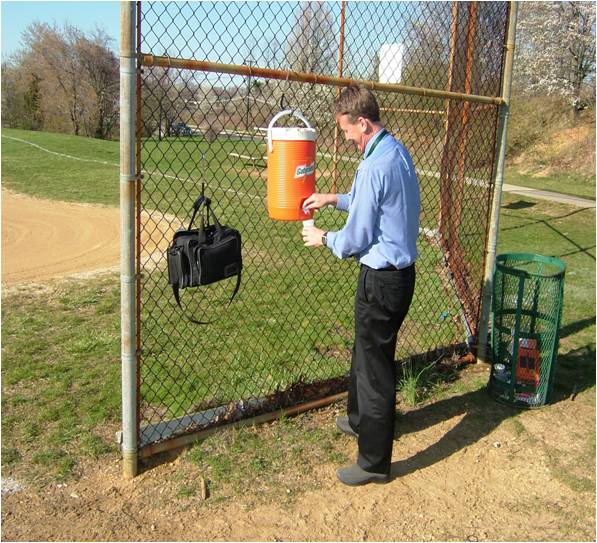
Using coolers for outdoors sports is a standard idea which can pose unique problems. For example, where can it be positioned so as not to take a seat on the bench, be on the ground making cups/bottles difficult to fill or get caught in the dust and dirt common to dugouts?

At a local hardware store, I purchased two standard rafter hangers. These are designed to go over the top of a 2”x 4” rafter beam and provide an arm for hanging items such as bicycles. Each hanger cost less than two dollars.


Sports such as baseball, softball, track and lacrosse commonly have fences around the field, in front of the dugout, or behind the bench. A very simple and inexpensive method to facilitate safety and ease of operation is to hang the cooler on the top rail of the fence (typically a 5-foot fence), on the fence itself or in the corner of the backstop.

Begin by positioning the cooler next to the fence. Place the longer arm into the handles of the cooler. By holding both the hanger and the handles of the cooler, lift the cooler up and place the hook end of the hanger onto the top rail of the fence. This places the spout at a very convenient level for the team to refill cups and bottles.


This idea can be used with coolers of all sizes. With handles across the top of smaller coolers, one hanger would suffice. First aid ice containers and first aid kits can be positioned in clear view with this simple hanger idea as well.

To improve hydration and replenishment for your athletes consider purchasing Gatorade, coolers and cup racks, and cups and bottles from www.esportshealth.com.

Phil Hossler, ATC has been an athletic trainer on the scholastic, collegiate and Olympic levels. He has authored 4 books and numerous articles and served as an officer in state and regional athletic training associations for 20 years. He is a member of four halls of fame including the National Athletic Trainers’ Association’s.